Every spring, tree trimming season kicks into high gear across neighborhoods everywhere. Homeowners grab ladders, rent chainsaws, and head into their yards with the best intentions. But the line between “manageable” and “genuinely over your head” is much closer than most people realize, and it moves depending on the tree, the location, and the tools involved.
We’re not here to tell you that you should never trim a tree yourself. A low branch that’s clearly within reach and away from any hazard is a reasonable DIY task. But there’s a lot more to this work than most people expect going in.
Here’s an honest look at professional tree trimming versus DIY, and where the real differences show up.
The Height Problem Is Worse Than You Think
Most tree trimming challenges involve working at height. And most people underestimate how quickly that becomes a factor.
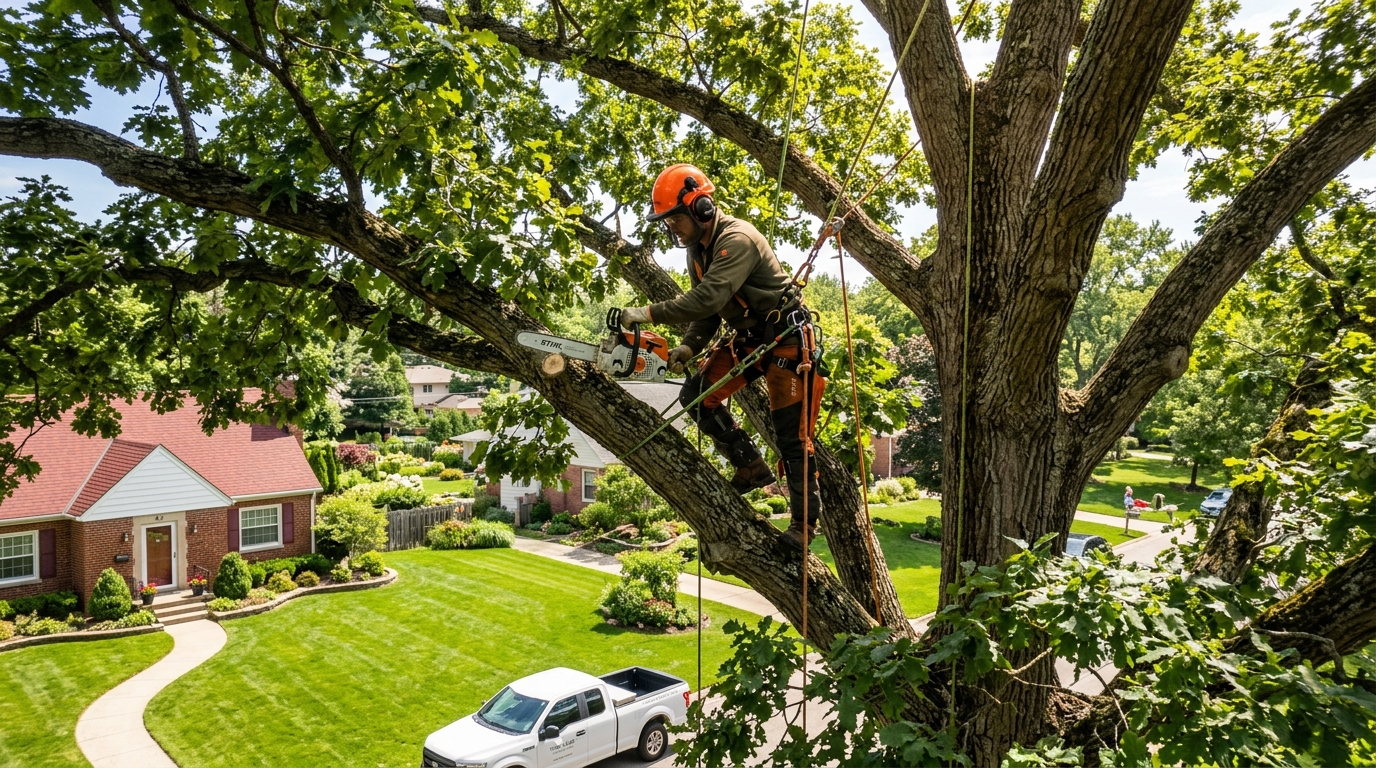
Professional tree crews train specifically for working at height. They use proper harnesses, lanyards, and rigging systems. They assess a tree before climbing it, looking for signs of structural weakness that would make certain positions unsafe. That assessment is not something you can learn from a YouTube video in an afternoon.
When you’re doing it recreationally with a rented chainsaw, you don’t have the training that makes professionals effective and controlled in those situations.
Cutting in the Wrong Place Harms the Tree
Here’s something most homeowners don’t know: where you cut matters as much as what you cut. Maybe more.
Trees have a specific structure at branch junctions called the branch collar, a slightly raised ring of tissue where the branch meets the trunk or a larger limb. Cutting through that collar, or leaving too much stub beyond it, affects how the tree heals the wound. A bad cut invites disease, rot, and insect damage at exactly the point where the tree is most vulnerable.
Proper pruning cuts angle away from the collar without cutting into it. That sounds simple. But on a branch with an odd angle, in a tight canopy, at height, with a running saw, making that exact cut cleanly is a skill. It’s one we develop through repetition on hundreds of trees.
The International Society of Arboriculture’s pruning standards go deep on this. The short version: improper cuts can shorten a tree’s life significantly, and that damage isn’t always visible right away. You might not notice what a bad trim did to a tree for two or three seasons.
What You’re Actually Hiring When You Hire a Pro
When we come out for a trimming job at J&B Land and Tree Services, the work itself is only part of what you’re paying for.
You’re paying for an assessment of the tree’s overall health, done by someone who has looked at a lot of trees. You’re paying for the right cuts in the right places. You’re paying for equipment that gets our crew safely into the canopy without them hanging off a ladder over your roof. And you’re paying for the debris to be handled and removed so your yard isn’t left looking like a storm came through.
We’ve run aerial equipment for tree work for years. The addition of our CMC 83HD Arbor Pro spider lift means we can now reach trees in situations that used to require creative, sometimes complicated solutions. That’s not just a selling point. It’s a genuine improvement in what we can offer on complex trimming jobs. You can read more about our aerial tree work capabilities if you’re curious about how we approach different job types.
The Cases Where DIY Actually Works
Fair is fair. Not every tree trimming situation requires a professional.
If you’re removing a small branch that’s clearly dead and it’s reachable from the ground or from a single step on a solid ladder, that’s reasonable. Small ornamental trees that you can easily reach without a ladder and without a chainsaw fall into the manageable category for most people. Hand pruners and loppers on branches under an inch in diameter, close to the ground, on a healthy tree in an open space, fine.
But the moment you’re pulling out a ladder, the moment a chainsaw is involved, the moment the branch is over a structure, a vehicle, or a fence, and the moment the tree itself shows any signs of disease or structural issues, the calculus changes. That’s when professional tree trimming versus DIY stops being a question of convenience and starts being a question of doing the job right and protecting your property.
The Cost Comparison People Always Ask About
This is the part of the conversation where I want to be straight with you.
Hiring a professional costs more than renting a chainsaw. That’s true. But consider what goes into the cost of DIY: equipment rental, your time, the physical labor, and the potential long-term cost to the tree if the work isn’t done correctly.
Most tree trimming jobs are not as expensive as people expect. And the peace of mind that comes from knowing the work was done properly is worth something real. We’ve had customers tell us they spent a weekend trying to handle a job themselves, made some cuts they weren’t sure about, and then called us anyway. That’s the outcome nobody wants.
Get a quote first. Talk to us about what you’re dealing with. The answer might surprise you in a good way. Our contact page is the easiest place to start.
The Bottom Line on Professional Tree Trimming vs DIY
We respect homeowners who want to take care of their own properties. That’s not a bad instinct. But tree work is the kind of task where experience, training, and the right equipment make a difference that’s hard to see until something goes wrong with the tree or your property.
At J&B Land and Tree Services, we do this work every day. Jonny built this business on knowing trees, knowing the equipment, and doing the job right. If you’ve got trimming work to get done this season, give us a call and let’s talk through what your trees actually need.