Most people wait too long. That’s the honest truth about tree removal.
We don’t say that to scare anyone or sell unnecessary work. We say it because we’ve been to properties after a tree has already come down on a fence, a shed, a car, or worse, part of a house. The homeowner always says the same thing: they knew something was wrong with that tree, they just weren’t sure it was bad enough to do something about.
Knowing when to remove a tree from your property is genuinely useful information. Not every struggling tree needs to come down. But some absolutely do, and knowing the difference can save you a significant amount of money, stress, and potential liability.
Here’s what we actually look for.
The Tree Is Dead or Mostly Dead
This one sounds obvious, but people still hesitate on it. A dead tree is a liability. Period.
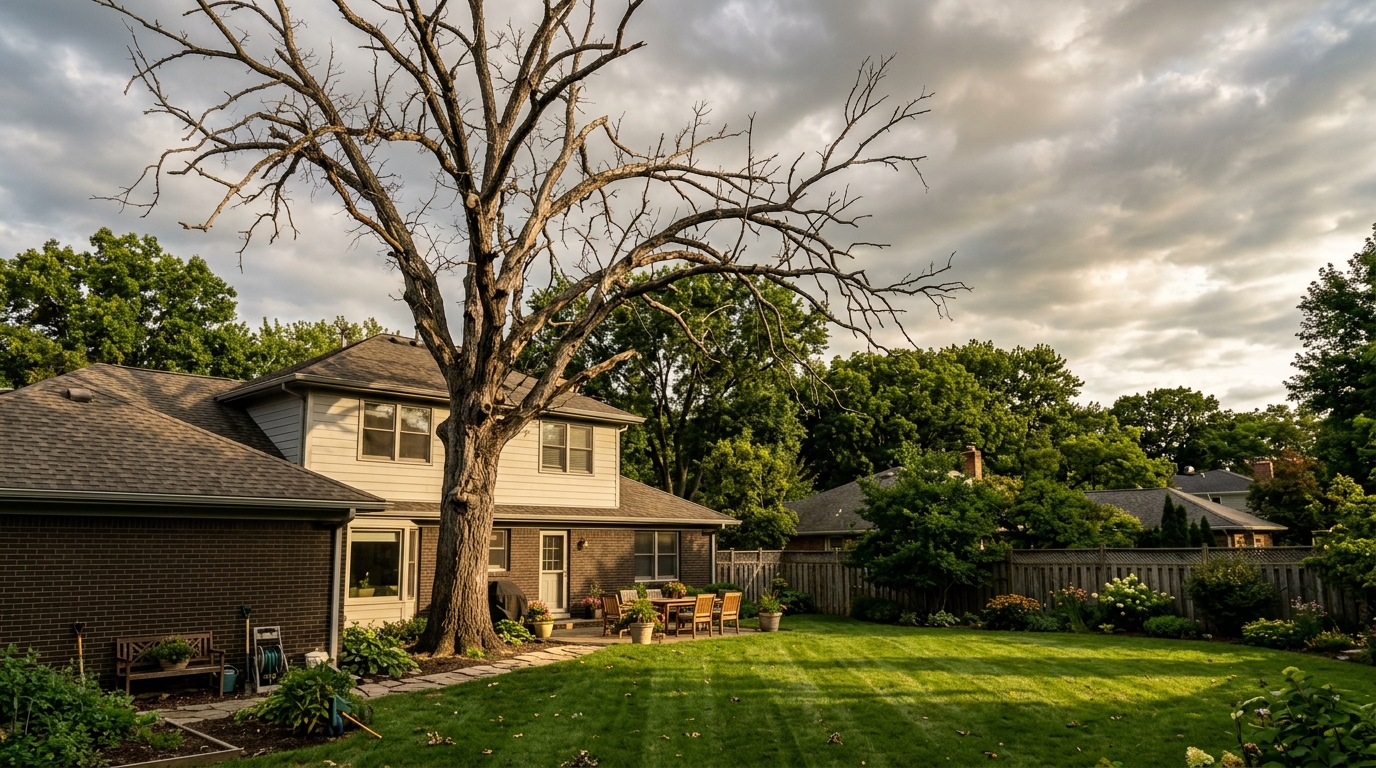
As wood dries out and the structure of the tree breaks down, it becomes unpredictable. Branches fall without warning. Root systems that once anchored the tree in the ground begin to rot, compromising the whole thing’s stability. A dead tree near a structure, a driveway, a vehicle, or anywhere people spend time is a problem waiting to happen.
Here in late spring, one of the easiest ways to spot a dead tree is the leaf test. If surrounding trees of the same species have fully leafed out and yours has nothing, or only sparse, patchy growth, that’s a serious signal. Scratch the bark on a small branch. Live wood is green just beneath the surface. Dead wood is brown and dry all the way through.
Some trees die in sections. A large portion of the crown goes dead while the lower part still looks fine. That dead wood up top is exactly what falls in a wind event, and it falls without warning.
The Root System Is Compromised
This is the one that catches people off guard because it’s not always visible.
If you’ve noticed the tree leaning more than it used to, especially if the lean increased after a storm or a stretch of saturated ground, that tree’s root system may be failing. Soil heaving near the base of the trunk, cracks in the ground extending outward from the root zone, or fungal growth at the base of the tree are all indicators of root decay.
According to the International Society of Arboriculture, root problems account for a significant percentage of unexpected tree failures, often because they’re harder to see than above-ground damage.
A tree with compromised roots can look perfectly healthy from the street. The canopy is full, the bark looks normal, nothing seems wrong. Until a strong wind hits and the whole thing tips. We’ve seen it happen, and it’s not the kind of thing you want to discover after the fact.
The Tree Is Structurally Unsound
Structural problems in trees take a few different forms. Some are obvious. Others, less so.
Co-dominant stems are one of the most common. That’s when a tree grows two main trunks from a single point, creating a V-shape junction that holds water and rots from the inside. Over time, that junction becomes a failure point. In a storm, it’s where the tree splits.
Large cracks or cavities in the trunk are another clear indicator. A tree can survive with a cavity for a long time, but that doesn’t mean it’s safe. Cavities reduce the structural integrity of the trunk. A certified arborist or an experienced tree service professional can assess how severe the risk actually is.
Leaning isn’t always a problem. Trees that have grown at an angle from the start have developed root systems that compensate for that lean. But a tree that has started leaning recently, or that leans toward a structure or high-traffic area, warrants a serious look.
If you’re uncertain, contact us and we’ll come take a look. We’d rather tell you the tree is fine than have you find out otherwise under bad circumstances.
It’s Too Close to a Structure
Sometimes the tree is reasonably healthy, but its location has become a problem. Trees planted years or decades ago that are now hanging over a roof, growing into a foundation, or dropping branches onto a driveway regularly are a specific kind of risk.
Root systems from large trees can affect foundations and underground utilities, especially in older homes where infrastructure wasn’t designed with a mature tree canopy nearby. If you’re seeing pavement heave, cracked sidewalks near a large tree, or drainage problems that seem to trace back to root intrusion, that’s worth investigating.
We also see a lot of trees that have grown too close to power lines. That’s a situation where tree trimming can sometimes manage the risk, but eventually, a tree in conflict with a power line needs to come out. Our aerial equipment gives us the reach and precision to handle these jobs safely. Learn more about our tree removal and aerial services for situations exactly like this.
After Storm Damage
Spring storm season means downed limbs, split trunks, and uprooted trees for a lot of property owners. Some storm-damaged trees can be saved with proper pruning. Others are too compromised to be worth trying to save, especially if the structural damage is significant.
The mistake people make after a storm is assuming that if the tree is still standing, it’s okay. A tree that lost major limbs in a storm has stress wounds that need to heal, and while some trees handle this fine, others decline rapidly. If a storm has visibly damaged a tree on your property, get eyes on it sooner rather than later.
We handle storm response work, including both emergency removal and post-storm assessment. If last night’s wind left you with a situation you’re not sure about, give us a call.
Trust Your Gut, Then Get a Professional Opinion
Here’s the simplest thing I can tell you: if a tree is making you nervous, take that seriously. Your instincts about your own property are usually picking up on something real. The tree leans a little more than you remember. It hasn’t looked healthy in a couple of years. The canopy seems thinner.
Those observations matter. Get a professional opinion before you dismiss them.
Knowing when to remove a tree from your property is about protecting your home, your investment, and your neighbors. At J&B Land and Tree Services, we give you a straight answer. If it needs to come down, we’ll tell you. If it doesn’t, we’ll tell you that too.
Reach out to us and let’s take a look before a problem becomes an emergency.